Beaked Whale Behavioral Responses to Navy Mid-Frequency Active Sonar.
Springer Cham. 2023.
Living reference work entry
More details
Collapse details
Date Published:
Publication:Ocean:Methods:
- August 22, 2023
Although beaked whales remain a cryptic and elusive family, much has been learned about their dive and foraging behavior in the last few decades through the use of passive acoustic monitoring (PAM) and a variety of tagging methods. Species-specific echolocation pulses can be used to acoustically track individuals and groups, and biologging tags provide information on dive and movement behavior. These technologies have also provided a window into how beaked whales behaviorally respond to Navy mid-frequency active sonar, which in turn may elucidate maladaptive behaviors that could lead to stranding. This chapter reviews existing knowledge about beaked whale behavioral responses to anthropogenic sound sources in general, and to Navy sonars in particular. By understanding the breadth of ways beaked whales behaviorally respond, the scientific community can continue to work toward recognizing and mitigating responses that could lead to stranding, as well as determining the population-level implications of impacts on individuals.
Complete
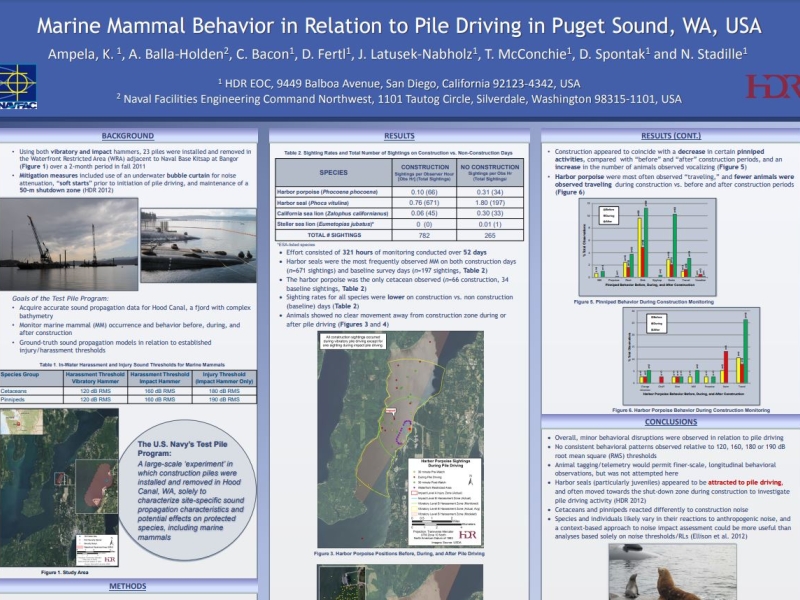
Aerial Surveys of Marine Mammals Conducted in the Inland Puget Sound Waters of Washington, summer 2013 – winter 2016
Project Objectives
1) Conduct aerial surveys during four seasonal periods within the inland Puget Sound Survey Area to assess potential differences in seasonal distribution, numbers, and behavioral state patterns of marine mammals; 2) Collect data to estimate densities of marine mammals in the inland Puget Sound waters for species with sufficient sightings; 3) Estimate abundance for each marine mammal species seen an adequate number of times; 4) Document the distribution and habitat use of each species observed; 5) Document and describe behaviors seen without performing focal follows.
Complete
Vessel-based Marine Mammal Surveys in Puget Sound, Washington
Project Objectives
Conduct marine mammal in-water vessel-based line transect surveys in the Puget Sound basin to: 1) Record data on all marine mammal species seen with the study area, with a focus on the killer whale (Orcinus orca) and the harbor porpoise (Phocoena phocoena). 2) Identify the seasonal occurrence and abundance/density of cetaceans within the study area. 3) Identify the effects of environmental variables on the distribution and abundance of species in the study area.No related blog posts to display