Currents (Navy's Environmental Magazine). 2011.
Fall 2012
More details
Collapse details
Date Published:
Publication:Ocean:Region:Species:Methods:
- September 1, 2011
In May 2011, a rare occurrence took place off the Southern California coast. For the first time since U.S. Navy-funded aerial surveys began in the area in 2008, a group of 20 sperm whales, including four calves, was seen—approximately 24 nautical miles west of San Diego.
Navy collaborates, monitors to better understand sea turtle movements in San Diego Bay.
Currents (Navy's Environmental Magazine). 2015.
Winter 2015/2016:6-13
More details
Collapse details
Date Published:
Filesize:
- December 1, 2015
Since the closure of a power plant in the southern part of San Diego Bay, a collaborative monitoring effort among the Navy, the National Marine Fisheries Service (NMFS) and others has been underway to better understand changes in the movement and behavior of the green sea turtle so that the Navy and this turtle can continue to share the resources in the bay. San Diego Bay is home to one of the largest U.S. Navy complexes in the world and California’s second largest incorporated city. Today, more than 25 percent of the U.S. Navy fleet is homeported in San Diego. Maintaining readiness in this ecosystem without causing harm to the natural resources is an ongoing challenge. There are a variety of threatened and endangered species that rely on the San Diego Bay ecosystem at different stages of their lives. One of these is the East Pacific green sea turtle. The East Pacific green sea turtle is a federally threatened species in San Diego Bay. While the majority of the population has traditionally lived in the quieter south part of the bay, the turtles may be venturing into areas more frequently used for U.S. Navy, recreational, and commercial activities. An increased presence of turtles outside of the southern portion of the bay may have potential implications for management of this species, as there is a higher likelihood of boat strikes and other potentially adverse human interactions.
- 2,037.95 KB
Complete
Acoustic and Visual Survey for Cetaceans in Behm Canal and Southern Clarence Strait, Alaska
Project Objectives
Conduct visual line-transect surveys and passive acoustic monitoring for cetaceans, and other marine mammals, to determine species occurrence, and to estimate density within Navy’s testing range. Acoustic monitoring devices will be deployed during the vessel based survey, and long-term passive acoustic hydrophones will be monitored for year-round detection of rare and/or cryptic cetacean species.
Complete
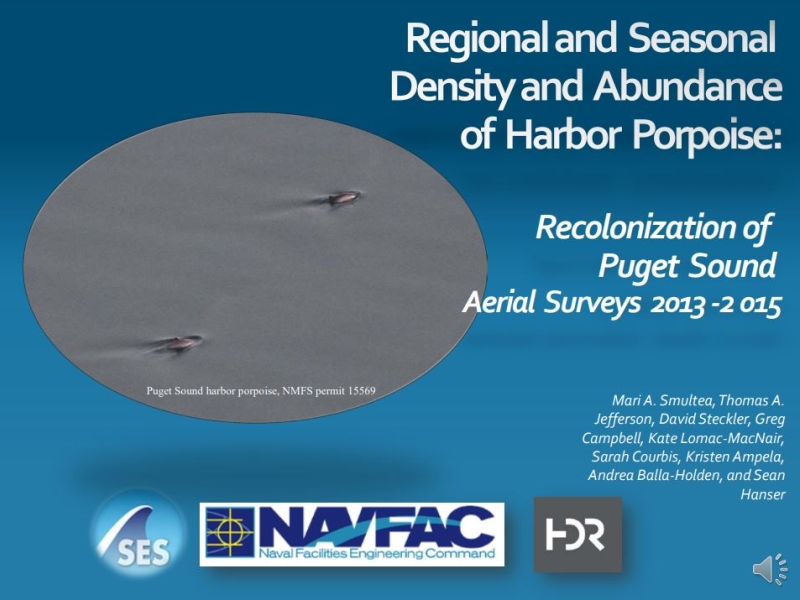
Aerial Surveys of Marine Mammals Conducted in the Inland Puget Sound Waters of Washington, summer 2013 – winter 2016
Project Objectives
1) Conduct aerial surveys during four seasonal periods within the inland Puget Sound Survey Area to assess potential differences in seasonal distribution, numbers, and behavioral state patterns of marine mammals; 2) Collect data to estimate densities of marine mammals in the inland Puget Sound waters for species with sufficient sightings; 3) Estimate abundance for each marine mammal species seen an adequate number of times; 4) Document the distribution and habitat use of each species observed; 5) Document and describe behaviors seen without performing focal follows.
Current
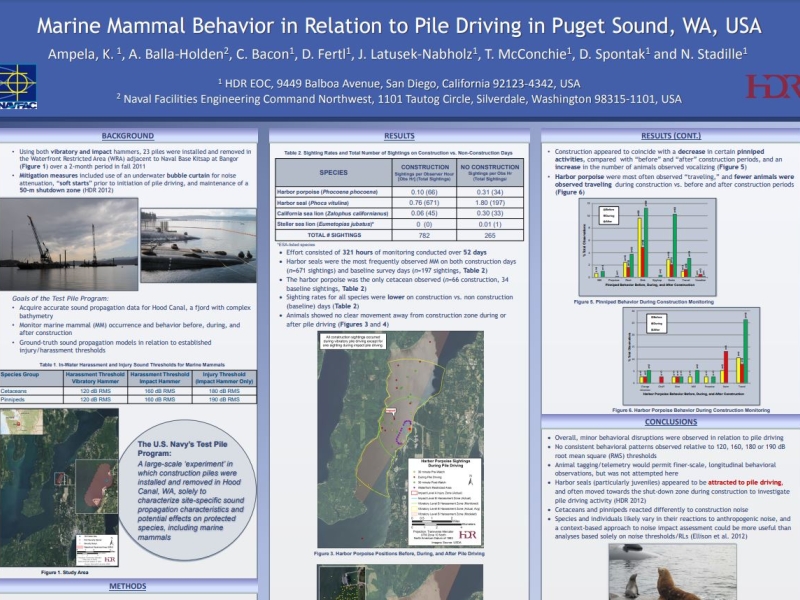
Monitoring Cetaceans in Hood Canal
Project Objectives
This 12‑month integrated pilot project combines three complementary components: (A) shore‑based theodolite monitoring of harbor porpoises, (B) high‑bandwidth passive acoustic monitoring and soundscape characterization, and (C) suction‑cup multi‑sensor tag deployments on Bigg’s (transient) killer whales. Together, these data streams will quantify occurrence, movement, diving, and behavioral context for these two key species in relation to the local soundscape—including operational signals near the Dabob Bay Range Complex (DBRC) and the Bangor Trident Base. Results can provide an empirical foundation and inform the study design of future cetacean behavioral response studies (BRS) in Hood Canal.
Complete
Occurrence, Distribution, and Density of Marine Mammals Near Naval Station Norfolk and Virginia Beach
Project Objectives
Assess occurrence, seasonality, and abundance of Tursiops in the coastal waters of Hampton Roads military installations
Current
Pacific Marine Assessment Program for Protected Species (PACMAPPS) survey
Project Objectives
Identify species of beaked whales, odontocetes, and baleen whales that occur in the surveyed areas; Monitor marine mammal and sea turtle presence, distribution, and diversity in offshore waters; Develop a better understanding of marine mammal distribution, movement patterns, habitat use, population structure, and abundance; Develop reference library of visually-validated acoustic recordings of marine mammals.
Current
Passive Acoustic Monitoring of Harbor Porpoises in Hood Canal
Project Objectives
This project was jointly funded through NAVSEA and the NUWC Keyport NISE program to address the Navy’s need for multi-year data on harbor porpoise occurrence and spatiotemporal distribution patterns in Hood Canal using passive acoustic monitoring (PAM).
Complete
Vessel-based Marine Mammal Surveys in Puget Sound, Washington
Project Objectives
Conduct marine mammal in-water vessel-based line transect surveys in the Puget Sound basin to: 1) Record data on all marine mammal species seen with the study area, with a focus on the killer whale (Orcinus orca) and the harbor porpoise (Phocoena phocoena). 2) Identify the seasonal occurrence and abundance/density of cetaceans within the study area. 3) Identify the effects of environmental variables on the distribution and abundance of species in the study area.No related blog posts to display