

US Navy

Marine Species Monitoring
Another CEE Trial – and Gervais’ beaked whales!
Every day working on pelagic cetaceans off Cape Hatteras is interesting and we seldom have a field day without learning something new. On Saturday, August 1st we were planning to conduct a Controlled Exposure Trial with simulated Continuous Active Sonar (CAS) signals played by our custom sound source to several tagged goose-beaked whales Ziphius cavirostris.
We had great working conditions for most of the day. The R/V Shearwater located one of the whales we tagged on July 17th (ZcTag169) at first light and this whale became the focal animal for our CAS playback. When the Shearwater crew first located ZcTag169, it was with four other beaked whales. Observers on the Shearwater noted that some of the other whales in the group were smaller than the tagged whale and had a distinctive striped pigmentation pattern, which was unusual.
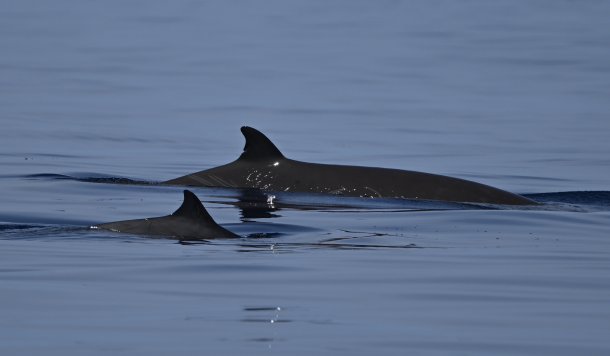 Focal goose-beaked whale ZcTag169 in the background with a Gervais’ beaked whale in the foreground. The antenna from the satellite-linked dive recorder is just visible below the notch on the trailing edge of the dorsal fin of ZcTag169. Photo by Meg Bradley.
The tagging team on the R/V Barber arrived on site at 9:40 and spent a couple of hours attempting to deploy a Digital Acoustic Tag (DTag) on one of the animals with ZcTag169. The DTag records very fine-scale data on movement and orientation and records sound, so it is a very useful complement to the satellite-linked dive recorders that we use more frequently in this project.
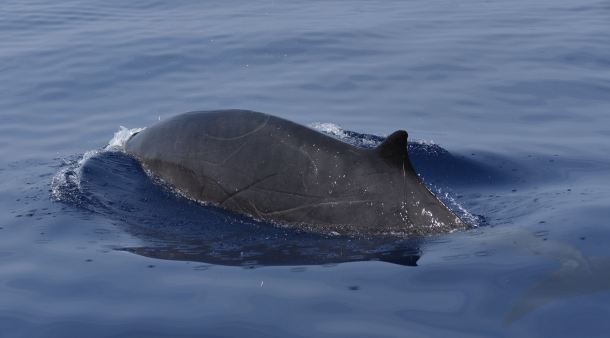 A heavily scarred male Gervais’ beaked whale. The distinctive dorsal stripes are visible. Photo by Andy Read.
During our attempts to deploy a DTag we confirmed the initial observations made by the Shearwater crew – the animals with ZcTag169 were smaller and had a distinctive pattern of tiger stripes on their dorsal surfaces. We were able to obtain several images of the heads of these animals, which showed erupted teeth (tusks) about one-third of the way back on their lower jaw – a diagnostic feature of the Gervais’ beaked whale Mesoplodon europaeus. Past aerial surveys of our area led by our friends at UNC Wilmington, and supported by the U.S. Navy Marine Species Monitoring Program, have documented the presence of Gervais’ beaked whales off Cape Hatteras, but this was the first time that we have seen a mixed group containing both species. Mixed species groups of beaked whales are rare, but have been recorded elsewhere (thanks to Bob Pitman for pointing us to these records).
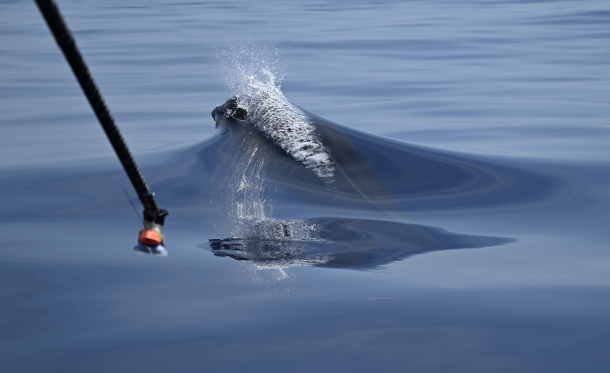 Attempting to attach a DTag to an adult male Gervais’ beaked whale. The tag is attached to a carbon fiber pole and is in the left foreground of the image. The erupted tooth (tusk) of the male beaked whale is evident on its left lower jaw as it breaks the surface. Photo by Meg Bradley.
We were not successful in deploying a DTag but were able to conduct a successful CEE trial with ZcTag169 in mid-afternoon. By the time we conducted a playback, ZcTag169 had left the Gervais’ beaked whales (or they left him) and was with another goose-beaked whale. We hope to focus future field work on deploying tags on Gervais’ beaked whales so that we can learn more about this enigmatic and poorly studied species.
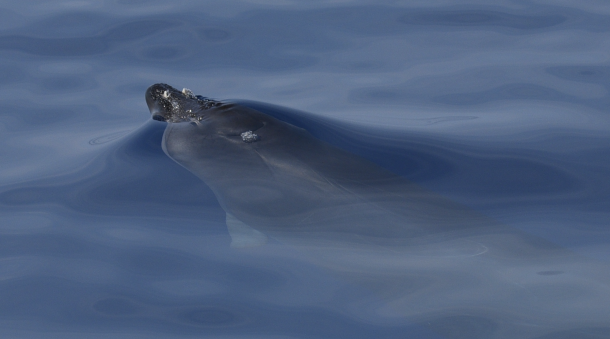 A close-up of the erupted tusks on a male Gervais’ beaked whale. Photo by Andy Read.

